Rogaine (Minoxidil)
Rogaine is the original brand of topical minoxidil for androgenetic alopecia, available as 2% and 5% solution and 5% foam over the counter for both men and women. Authorised generics are widely available at lower cost and are clinically equivalent.
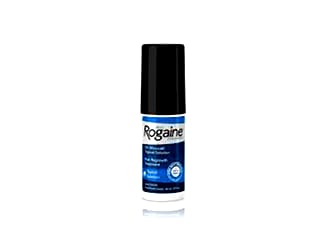
- Active ingredients
- Minoxidil
- Manufacturer
- Johnson & Johnson
- Category
- Male and Female Pattern Hair Loss
What is it?
Rogaine is the brand name under which Johnson & Johnson markets topical minoxidil for hair loss; it was the first FDA-approved topical hair-loss treatment, launched as a 2% solution by Upjohn in 1988. It is available over the counter in the US and many countries as 2% and 5% liquid solution and 5% foam, in formulations marketed for men and women. Authorised generic minoxidil topical products dominate the market today and are clinically equivalent to Rogaine at the same strength and base.
Active ingredients
Each Rogaine product contains minoxidil 2% (women's solution) or 5% (men's solution and foam in many markets, women's foam in the US). The active substance is identical between branded Rogaine and authorised generic topical minoxidil at the same strength, with bioequivalence required by the regulator. The 5% foam version is sometimes preferred by users who find the propylene glycol vehicle in the solution irritating.
Forms and dosages
Rogaine is supplied as 2% topical solution (1 mL twice daily), 5% topical solution (1 mL twice daily, men) and 5% foam (half capful twice daily, men; half capful once daily, women). The product is applied to the dry scalp in the area of thinning, allowed to dry, and not washed off for at least 4 hours. Hands should be washed after application; transfer to face or partner can cause unwanted hair growth.
Indications
Rogaine is approved for androgenetic alopecia (male and female pattern hair loss) in adults. It is not used for alopecia areata, telogen effluvium or scarring alopecia. Onset of cosmetically meaningful regrowth typically takes 3–6 months of consistent use; results stabilise around 12 months. Continuous use is required to maintain benefit; benefit is lost within 3–6 months of stopping.
How it works
Minoxidil is a potassium channel opener that produces local arteriolar vasodilation. Its hair-follicle effect appears to prolong the anagen (growth) phase, enlarge miniaturised follicles and increase blood flow to the dermal papilla. The active metabolite minoxidil sulfate is generated by sulfotransferase enzymes in the scalp; individual variation in this enzyme partly explains why some users respond and others do not. About 40% of users see meaningful regrowth, 40% see stabilisation and 20% continue to lose hair.
Frequently asked questions
Why is Rogaine causing more shedding in the first weeks? ▾
When minoxidil is started, follicles in the resting (telogen) phase are pushed into a new growth (anagen) phase. The transition expels the existing telogen hair, producing a temporary increase in shedding for 4–8 weeks. According to clinical practice, this paradoxical shedding is a sign the medication is working and should not prompt discontinuation.
Should I use 2% or 5% Rogaine? ▾
5% is more effective than 2% in clinical trials but causes slightly more local irritation. Men typically use 5% solution or foam; women in the US often use 5% foam (once daily) or 2% solution (twice daily). According to the prescribing information, choice is based on tolerability, gender of the user and product label in the relevant market.
Can Rogaine be combined with finasteride? ▾
Yes — combination of topical minoxidil and oral finasteride is standard practice for moderate-to-severe male pattern hair loss because they act by different mechanisms (vasodilator vs DHT-suppressor). According to current dermatology guidelines, combination therapy is more effective than either alone, though side effect profiles add.
How long until I see results from Rogaine? ▾
Cosmetically meaningful regrowth typically takes 3–6 months of consistent twice-daily use; results stabilise around 12 months. Initial shedding (4–8 weeks) is paradoxical and resolves. Stopping use leads to loss of any gained hair within 3–6 months. Patience and adherence are the main predictors of visible benefit.
Is Rogaine the same as generic minoxidil? ▾
Yes — Rogaine and authorised generic minoxidil topical products contain the same active ingredient at the same strengths and have demonstrated bioequivalence. The generic is significantly cheaper and clinically equivalent in nearly all cases. The Rogaine trademark remains widely recognised but most current use is on authorised generics.
Related medications


Sources
This page is compiled from the official prescribing information for Minoxidil. The links below open a search for that active ingredient in each register, so you always reach the current version of the label rather than a cached copy.
The information on this website is provided for reference and educational purposes only. It does not replace consultation with a qualified healthcare professional.