Effexor (Venlafaxine XR)
Effexor is the brand of venlafaxine extended-release capsules, an SNRI for major depression, generalised anxiety, social anxiety and panic disorder. Originally Wyeth, now Pfizer; authorised generics widely available with bioequivalent activity.
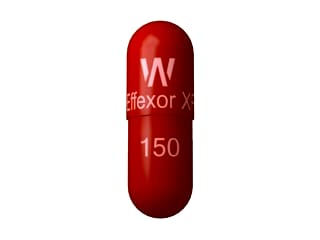
- Active ingredients
- Venlafaxine
- Manufacturer
- Wyeth/Pfizer
- Dosage forms
- capsule
- Category
- Anti-Depressants
What is it?
Effexor is the originator brand of venlafaxine, the first SNRI introduced into clinical use, FDA approved in 1993 by Wyeth (now Pfizer). The XR (extended-release) capsule formulation became standard because it allows once-daily dosing and reduces peak-trough fluctuations that drive nausea. Authorised generic venlafaxine XR is widely available; the molecule is on the WHO Essential Medicines List.
Active ingredients
Each Effexor XR capsule contains venlafaxine hydrochloride in extended-release pellets. Venlafaxine is an SNRI with a dose-dependent profile: at low doses (≤75mg) it acts mainly on serotonin like an SSRI, while at higher doses (150mg+) the norepinephrine effect becomes substantial. The 37.5mg, 75mg and 150mg strengths cover initiation, target dose and high-dose use.
Forms and dosages
Effexor XR is supplied as two-toned capsules in 37.5mg, 75mg and 150mg strengths. The recommended starting dose is 75mg once daily; some users begin at 37.5mg for the first week to improve tolerability. The target dose is 75–225mg daily depending on indication and response. Capsules can be swallowed whole or, if swallowing is difficult, opened and the pellets sprinkled on a spoonful of soft food and swallowed immediately without chewing.
Indications
Effexor XR is approved for major depressive disorder, generalised anxiety disorder, social anxiety disorder and panic disorder. Off-label uses include menopausal vasomotor symptoms (hot flashes), neuropathic pain and post-traumatic stress disorder. It is generally considered second-line after SSRIs for depression, or first-line in cases where stronger antidepressant effect is needed or where prior SSRI response has been inadequate.
How it works
Effexor inhibits the reuptake of both serotonin and norepinephrine at the synapse. At doses up to 75mg the serotonin effect dominates; at higher doses the norepinephrine effect becomes meaningful, which can drive both stronger antidepressant action and dose-related blood pressure increase. The therapeutic effect develops over 4–6 weeks. The active metabolite desvenlafaxine extends the action and is itself marketed as Pristiq.
Frequently asked questions
Why do people warn about stopping Effexor? ▾
Effexor has a particularly notorious discontinuation syndrome — abrupt cessation produces dizziness, sensory disturbances ('brain zaps'), flu-like symptoms and emotional lability — because of the short half-life of the parent compound. According to the prescribing information, Effexor must be tapered gradually (75mg or 37.5mg reductions every 2 weeks) rather than stopped abruptly, even after short-term use.
Will Effexor raise my blood pressure? ▾
Dose-related blood pressure increase is a recognised effect, particularly at doses >150mg/day. According to the prescribing information, baseline blood pressure should be checked before starting and monitored periodically during treatment, with dose reduction or alternative therapy if hypertension develops.
How is Effexor different from Cymbalta? ▾
Both are SNRIs, but Effexor has a shorter half-life (5h parent, 11h metabolite vs ~12h for Cymbalta) and a notable dose-dependent profile (SSRI-like at low doses, true SNRI at higher). Cymbalta has stronger evidence in chronic pain. Discontinuation syndrome is more pronounced with Effexor. The choice between them depends on indication and individual tolerance.
How long does Effexor take to work? ▾
Some users notice mood and sleep improvements within 1–2 weeks, but full antidepressant effect typically requires 4–6 weeks of consistent dosing at the target dose. Anxiety symptoms may improve faster than depressive symptoms. The medication should not be judged ineffective before 4–6 weeks at an adequate dose.
Should I take Effexor in the morning or evening? ▾
Either is acceptable. Some users find Effexor activating and prefer morning dosing; others find it sedating and prefer evening. Consistency matters more than the specific time. Food does not significantly affect absorption from the XR formulation.
Related medications


Sources
This page is compiled from the official prescribing information for Venlafaxine. The links below open a search for that active ingredient in each register, so you always reach the current version of the label rather than a cached copy.
The information on this website is provided for reference and educational purposes only. It does not replace consultation with a qualified healthcare professional.